What safeguarding technology should actually do (and what most of it misses)
The safeguarding software market is crowded. Schools, care homes, and local authorities can choose from dozens of platforms offering to manage referrals, log concerns, track cases, and generate compliance reports.
Most of this software does those things adequately. Almost none of it is useful at the moment when someone actually needs help.
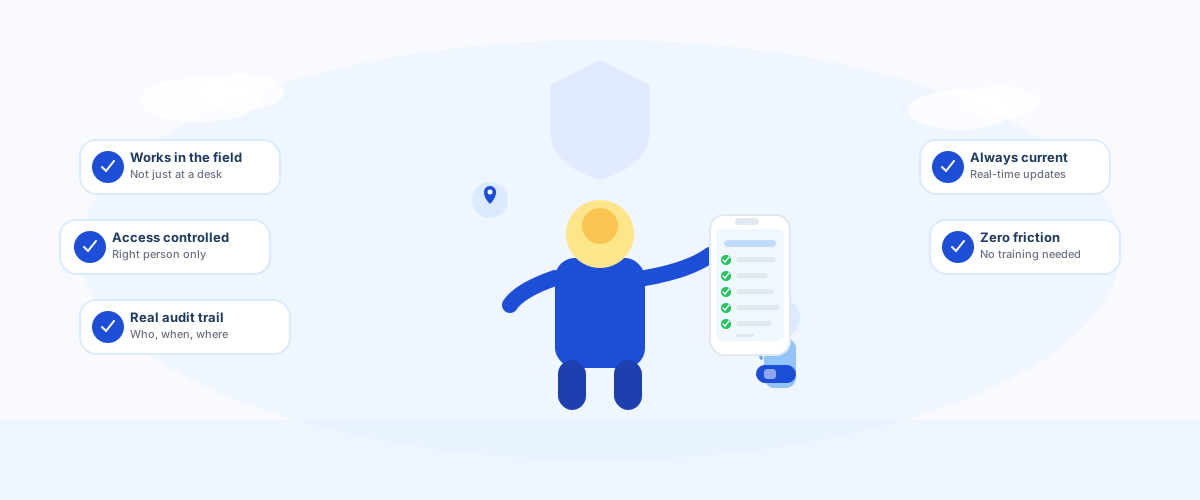
It needs to work in the field, not just in the office
Most safeguarding tools are built for desk use. They require a login, a browser, and a stable internet connection. They are designed for the administrative task: recording what happened, building a timeline for a review, generating reports.
This work matters. But the person who matters most in a safeguarding emergency is not the DSL at their desk on a Thursday afternoon. It is the teaching assistant who finds a distressed child in the corridor between lessons, the community care worker who arrives at a home visit and something is wrong, the paramedic who encounters a non-verbal patient alone with no carer nearby.
These people need information in seconds. They cannot open a case management system. Technology built for safeguarding administration is not built for safeguarding emergencies — and treating them as the same problem produces software that fails at the moment it is most needed.
It needs to reach the right person, not everyone
Organisations managing access to sensitive information tend to choose one of two approaches: lock it down so tightly that the people who need it cannot get to it in time, or share it so broadly that data protection becomes an afterthought.
Giving all staff access to all pupil or resident profiles simplifies the admin. It does not comply with UK GDPR. Health and medical information is special category data. It should be accessible only to those with a genuine need, and that access should be auditable and revocable.
Effective safeguarding technology should make it straightforward to grant access to specific individuals or teams, easy to remove that access when circumstances change — a staff member leaves, a placement ends — and impossible for anyone outside the authorised list to view the profile.
It needs an audit trail that actually means something
Most systems log file access. A record showing "user viewed record at 14:32" does not constitute a meaningful audit trail.
What matters in a safeguarding review: who accessed the profile, when, from where, and on behalf of which organisation. If the person who accessed a child's record was a police officer, that should be recorded. If it was someone from a different agency, that should be recorded. If someone who should not have had access attempted to view a profile, the owner should be notified immediately.
This kind of accountability makes it possible to reconstruct exactly what happened during an incident — which matters for the safety of the individual and for the organisation's ability to demonstrate that appropriate processes were followed.
It needs to stay current without relying on an administrator
Information captured at a care planning meeting has a shelf life. Conditions are managed differently over time. Emergency contacts change. The approach that worked two years ago may be actively counterproductive now.
Technology that stores static documents faces the same problem as paper — it reflects a point in time, not the present situation. The practical test is whether a change made today is reflected the next time someone needs the information, without requiring anyone to print, distribute, and file a revised version.
It needs to work without specialist training
A first responder encountering an unfamiliar person should not need to be trained on a specific platform to access their critical information. A teacher covering an absent colleague should not need to know which shared folder to look in.
Safeguarding technology that requires expertise to operate in a crisis will not be used in a crisis. The interface for accessing information at the point it is needed must work for anyone holding a smartphone — no account, no training, no delay.
The distinction worth making
Not every safeguarding tool needs to do all of these things. Case management platforms serve a real purpose. Incident reporting and compliance tracking are necessary functions.
But for the specific problem of getting critical information to an authorised person at the moment they need it, the requirements are clear: the information must be carried by the person it describes, accessible in seconds, available only to those who should have it, with a meaningful record of every access, and current as of the last update.
That is a different product from a case management system. It is worth being deliberate about which problem you are solving before you choose a tool.
Try SentinelTag
Set up your first emergency profile in minutes. Available now for Android.